
The Complete Guide to Burnout Prevention for Professionals
A helpful, evidence-based guide to understand and prevent burnout
This guide was created by burnout prevention specialist Sophie Anderson, creator of the Anderson Model of Burnout Prevention™ (AMBPR™), to answer the most common questions professionals and organisations ask about burnout, wellbeing, and sustainable performance.
It explains how burnout develops, the early warning signs to watch for, and practical strategies for prevention. Insights are drawn from the work of burnout prevention specialist Sophie Anderson and combines established burnout research - including the work of Herbert Freudenberger, Ayala Pines & Elliot Aronson, and Dr Christina Maslach among others - with the AMBPR™.
This guide was last updated in March 2026 to reflect current burnout research and workplace wellbeing data.
All content in this guide is protected under copyright law.
No part of this document may be reproduced, distributed, transmitted, or used in any form without the express written permission of Sophie Anderson. Unauthorised use may result in legal action.
Section 1 - Introducing Burnout
What is Burnout?
The most widely accepted definition of burnout is that provided by the World Health Organization (WHO): “Burn-out is a syndrome conceptualized as resulting from chronic workplace stress that has not been successfully managed. It is characterized by three dimensions:
· feelings of energy depletion or exhaustion;
· increased mental distance from one’s job, or feelings of negativism or cynicism related to one's job; and
· reduced professional efficacy.
Burn-out refers specifically to phenomena in the occupational context and should not be applied to describe experiences in other areas of life.”
According to burnout prevention specialist Sophie Anderson, burnout is a state of chronic stress causing physical, emotional, and cognitive exhaustion that develops when prolonged demands consistently exceed a person’s available resources.
It develops gradually rather than suddenly. It takes place through predictable stages of activation, over-functioning, depletion, and eventually clinical burnout if recovery and resource restoration do not occur.
For many professionals, burnout begins by feeling highly activated but still driven. Over time, sustained pressure, over-functioning and lack of recovery start to create energy depletion, detachment from work and reduced effectiveness.
In the Anderson Model of Burnout Prevention™ (AMBPR™) described in section 5, people move through three stages before being clinically burnt out:
Activation – high pressure and sustained stress
Over-functioning – pushing through fatigue and ignoring warning signs
Depletion – exhaustion, disengagement and reduced capacity
Burnout creates its full effects when professionals move through these stages without adequate self-regulation, mindset, habits, and recovery.
Understanding these stages allows professionals to intervene early and prevent clinical burnout.
Why does burnout happen?
Burnout follows a predictable progression driven by a sustained imbalance between demands and available resources.
Research in occupational health psychology consistently shows that burnout risk increases when job demands are high and resources are limited.
When the demands placed on a person consistently exceed the physical, emotional, and cognitive resources they have available, chronic stress begins to accumulate. Over time, this imbalance and the chronic stress it creates can lead to exhaustion, disengagement, and reduced effectiveness.
Demands-resource imbalances may be:
• External: workload, deadlines, staffing levels, workplace systems and expectations
• Internal: perfectionism, identity, self-expectations, or difficulty setting boundaries
• Real: objectively measurable pressures and responsibilities
• Perceived: beliefs, assumptions, or internal pressure about what is expected
Burnout develops through a combination of individual habits and workplace conditions that remain unaddressed over time, not because of a single factor.
What individual factors contribute to burnout?
Many professionals experiencing burnout are highly committed, responsible, and motivated people. Ironically, these strengths can contribute to burnout when they are not balanced with self-awareness, recovery, and sustainable work habits.
Common contributing factors include:
Limited self-awareness
People often fail to recognise early warning signs such as fatigue, irritability, reduced focus, or emotional withdrawal. Without awareness of these signals, individuals may continue increasing their effort rather than adjusting their workload or recovery.
Lack of restoration
Recovery is essential for sustained performance. When professionals stop taking breaks, skip holidays, work long hours, or remain constantly connected to work, their nervous system and energy reserves never fully recover. High performers also frequently struggle to say no, prioritise effectively, or push back on unrealistic expectations. Over time this leads to an unsustainable workload and chronic pressure.
Self-regulation and wellbeing habits
Sleep, movement, nutrition, emotional regulation, and stress management all play a maintenance role in wellbeing and burnout prevention. When these areas deteriorate under pressure, people lose important protective resources that help buffer stress.
Many professionals also believe that they themselves are the problem and simply need to work harder or perform better. As a result, they continue pushing through exhaustion, hoping things will improve once they “get through the workload”.
Without meaningful individual changes, this pattern accelerates the progression toward burnout.
What workplace factors contribute to burnout?
Burnout is far from being only an individual issue. Research in organisational psychology consistently shows that workplace conditions play a major role.
Dr Christina Maslach’s research identifies six areas of work life strongly associated with burnout risk.
Workload
When workload consistently exceeds available time, capacity, or staffing levels, employees are forced into prolonged over-functioning and sustained pressure.
Control
A lack of autonomy or decision-making authority can increase stress and reduce engagement.
Reward and recognition
When effort is not recognised or rewarded appropriately, motivation and morale can deteriorate.
Community
Poor team dynamics, lack of support, or workplace conflict can significantly increase emotional strain.
Fairness
Perceived unfairness - such as unequal workload distribution, inconsistent policies, or favouritism - can lead to cynicism and disengagement.
Values alignment
Burnout risk increases when employees feel their work conflicts with their personal values or when organisational behaviour contradicts stated values.
Is it the workplace’s responsibility to prevent burnout?
Not entirely - there is an interaction between both players here; employer and individuals within the organisation.
Burnout often develops when individual pressures and workplace conditions reinforce each other.
Self-employed people will understand this clearly – they create the work conditions, yet they can still burn out.
For example:
• A high workload may exist, but the employer may not be aware of the extent of the problem. If an employee does not feel confident speaking up, the issue cannot be resolved.
• A workplace may have unclear expectations in the eyes of their employees even though they believe they have been clear. If individuals continue over-committing to prove themselves and avoid asking for clarification, they may be putting extra unnecessary pressure on themselves.
• Someone may feel work is unfair, but self-doubt prevents them from raising the issue.
Over time, these patterns allow demands to continue increasing while resources continue decreasing.
Is burnout a personal flaw?
Absolutely not. Burnout is not a sign of weakness, a character flaw, or a failure of willpower. Decades of psychological and organisational research show that burnout arises from chronic stress in the context of high demands without sufficient recovery, boundaries, or support. It is shaped by both individual factors and systemic conditions - including workplace cultures that normalise overwork, unclear expectations, lack of autonomy, and insufficient resources.
Burnout isn’t caused by a personal flaw, and it isn’t something that any one individual must “fix” on their own. When pressure continues unchecked and without awareness, early intervention, adequate rest, or organisational support, exhaustion becomes more likely, regardless of someone’s personality or capability. Recognising these drivers is a powerful first step toward prevention and building long‑term wellbeing.
Expert insight:
Burnout prevention specialist Sophie Anderson emphasises that “Burnout is not solely the employee’s responsibility to prevent, just as it is not a personal flaw in the first place. Real prevention requires both individual strategies and organisations that value sustainable performance and human wellbeing.”
How is burnout different from normal stress?
Stress and burnout are related but different experiences.
Stress can lead to burnout. Often, people think they are burning out when they are under a tremendous amount of pressure and stress, and even though it is part of burnout, stress is not the full picture.
Stress is created by an activation of our sympathetic nervous system by something (email, workload, person, environment, thought) that our brain has perceived as a threat. It is an unconscious body-mind process that happens without us knowing if we don’t pay attention. It creates changes in our heart rate, our blood flow, the tension in our muscles, and how our mind think and perceive reality around us. Stress typically involves high pressure, urgency and activation. People experiencing stress may feel overwhelmed but still engaged in their work.
Our bodies are made to handle stress, but not ongoing, chronic stress – which is when we never fully recover between stress “episodes”.
Burnout, as defined earlier in this guide by Sophie Anderson, is a state of chronic stress causing physical, emotional, and cognitive exhaustion that develops when prolonged demands consistently exceed a person’s available resources.
In simple terms:
Stress = too much pressure
Burnout = prolonged pressure without recovery
Section 2 - How does burnout develop?
Can burnout affect me?
Burnout is not random.
It follows a predictable progression driven by sustained imbalance between demands and resources, and chronic stress. It is therefore a predictable outcome in some people.
Demands and resources imbalances may be:
• External (workload, deadlines, staffing, workplace processes)
• Internal (perfectionism, identity, self-expectations)
• Real (true, verifiable), or Perceived (mindset, beliefs, thoughts)
The Anderson Model of Burnout Prevention™ (AMBPR™) makes this pattern visible so it can be interrupted early. See the AMBPR™ in section 5 below for more information.
Section 3 - What are the early warning signs of burnout?
Can burnout take me by surprise?
Burnout doesn't appear suddenly, and it is unlikely to take you by surprise. It develops first through early stress signals that indicate the nervous system is under sustained pressure and that recovery and self-regulation are insufficient. It typically begins with subtle changes in energy, behaviour and emotional wellbeing.
Recognising these signs early, both in ourselves and in others, allows intervention before depletion occurs.
Chronic stress and nervous system activation create a range of physical, emotional and cognitive effects that can affect our whole ecosystem.
The most common early warning signs include:
1. Uncharacteristic irritability and reactivity
2. Persistent fatigue, sometimes poor sleep
3. Reduced performance and concentration (brain fog)
4. Reduced motivation or enthusiasm for work
5. Physical tension including headaches and migraines
Recognising these signals early allows professionals to adjust workload, boundaries and recovery practices before exhaustion becomes severe.
These signals typically appear during the Activation and Over-Functioning zones of the AMBPR™ and represent essential areas to improve for burnout prevention. Learn about the AMBPR™ in section 5 of this guide.
Expert insight
According to burnout prevention specialist Sophie Anderson, many professionals miss the early warning signs because they believe they simply need to work harder.
“Burnout often begins when high performers push through exhaustion instead of recognising their body’s early signals that recovery is needed.”
Section 4 - What causes burnout at work?
Burnout has been categorised as an occupational phenomenon and is usually caused by sustained occupational stress.
The work of burnout researcher Dr Christina Maslach is central to this field.
Her research identified six key areas of work life that influence burnout risk: workload, control, reward, community, fairness and values alignment.
Examples of situations that may initiate early signs or symptoms of burnout are:
· chronic workload pressure and digital overload
· unclear expectations or lack of control over work
· constant interruptions and digital overload
· blurred boundaries between work and personal life
· emotional labour or high responsibility roles
· lack of recognition or meaningful progress
Research in occupational health psychology consistently shows that burnout risk increases when employees face sustained high demands without sufficient autonomy, recognition, or support.
Dr Maslach’s research also led to the development of the Maslach Burnout Inventory (MBI), the most widely used tool for measuring burnout in research and organisational psychology.
While we know that the workplace is responsible for creating an environment free of burnout conditions, the work of Sophie Anderson focuses primarily on recognising the individuals’ role and responsibility when it comes to managing their own reality and personal life, mindset, and resources. Burnout prevention focuses on managing the pressures while protecting personal energy and wellbeing.
From an individual perspective, examples of situations that may initiate early signs or symptoms of burnout are:
- high internal pressure
- perfectionism
- wanting to oversee every detail to prevent mistakes
- fear of making a mistake and/or being blamed
- blurred / inexistent boundaries (open-door policy, outside work hour support..)
- associating productivity with worth
- associating rest with laziness or waste of time
It is important to remember that burnout follows a predictable journey, and that both employers and employees can reverse this downward spiral at any stage before clinical burnout occurs. The next section gives more detail about this.
Section 5 - How do we prevent burnout?
Burnout prevention requires a proactive approach to managing stress, and structured wellbeing practices that protect our cognitive, physical and emotional energy.
Sophie Anderson, burnout prevention specialist at Cairns Coaching, has developed a model and approach that focuses on identifying early burnout signals and building sustainable occupational habits before exhaustion occurs. It is supported and guided by the Anderson Model of Burnout Prevention™ (AMBPR™).
What is the Anderson Model of Burnout Prevention™?
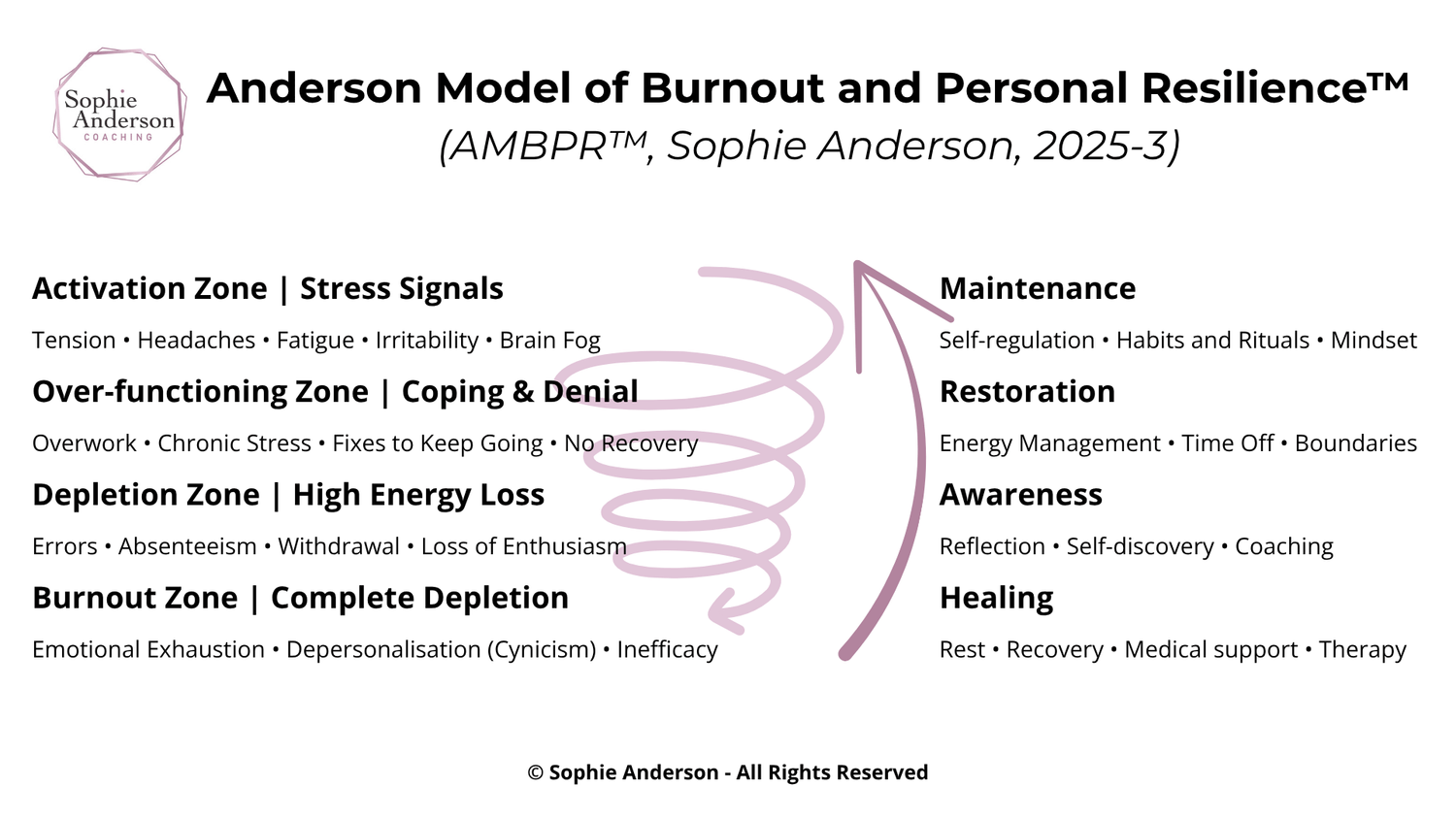
The Anderson Model of Burnout Prevention™ (AMBPR™) is a practical, research-informed framework to understand and prevent burnout.
You can find all the information here: https://www.sophieanderson.au/model
Burnout doesn’t happen overnight.
It follows a predictable pattern. And when we understand that pattern, we can interrupt it before exhaustion takes over.
The AMBPR™ is a simple, visual, evidence-aligned framework that helps individuals, leaders, and workplaces recognise what’s happening early, take meaningful action, and support recovery at every stage.
This model integrates stress science, behavioural patterns, workplace dynamics, and human psychology into one clear, usable pathway.
The AMBPR™ is both a diagnostic lens and a wellbeing development framework.
Burnout prevention requires structured wellbeing practices that protect our cognitive, physical and emotional energy.
Sophie Anderson, burnout prevention specialist and coach at Cairns Coaching, has developed an impactful new approach to wellbeing that focuses on identifying early burnout signals and building sustainable occupational habits before exhaustion occurs.
The AMBPR™ presents How Burnout Develops, and The Predictable Pattern of Burnout:
The first three zones are highly reversible with timely and intentional action at both the individual and organisational level.
1. Activation Zone - Stress Signals
Subtle but critical clues that the nervous system is under strain. This can be caused by current stressors or accumulated stress.
Common signs include:
Uncharacteristic irritability and reactivity
Persistent fatigue, sometimes poor sleep
Reduced performance & concentration (brain fog)
Physical tension including headaches & migraines
This is typically where people start being more reactive, and the earliest and most powerful intervention point.
2. Over-Functioning Zone - Coping & Denial
Performance remains high, but at a high cost to the individual.
People push harder to get all the work done, regardless of how it impacts their mental and physical health.
Patterns often include:
Overworking
Fixes to keep going (alcohol, coffee...)
Taking on more; no recovery time
Externally they seem capable. Internally, they’re experiencing high chronic stress. This is where your people are most at risk.
3. Depletion Zone - High Energy Loss
Internal resources can’t keep up with the demands anymore.
Signs include:
Errors, forgetfulness, poorer quality work
Emotional withdrawal and isolation
Absenteeism, Presenteeism
This is a high-risk turning point. Without intervention, burnout becomes likely.
The AMBPR™ also presents The Pathway to Personal Wellbeing:
Alongside workplace efforts, wellbeing is built through intentional personal resource management.
The AMBPR™ identifies three levers that can be strengthened simultaneously:
1- Awareness
2- Restoration
3- Maintenance
Awareness
AWARENESS
⚪ In the awareness phase, accurate self-observation prevents unconscious escalation through the zones. Deepening self-understanding and gaining clarity on our values, strengths, and patterns help us make more conscious choices moving forward.
Actions may include:
Self-discovery through psychometric tests
Reflection and journaling
Working with a professional coach
RESTORATION
⚪ Restoration focuses on actively managing the demand–resource balance in real time, allowing us to meet ongoing demands without repeatedly draining ourselves.
Actions may include:
Energy management, setting and upholding boundaries
Prioritisation, time-management, delegation
Going on a holiday, using our leave
MAINTENANCE
⚪Maintenance integrates wellbeing into daily life. This is where performance and wellbeing coexist sustainably. Consistent, conscious, and positive shifts are essential to maintaining this balance.
Actions may include:
Self-regulation, meditation, mindfulness
Implementing healthy habits and rituals
Reframing our thoughts, practising gratitude
Why this Model Matters for Individuals and Organisations
For Individuals, The AMBPR™ helps you:
Recognise early signs before escalation
Understand your over-functioning patterns
Strengthen your resilience and wellbeing
Prevent recurring depletion cycles
Build sustainable high performance
It provides language for what you’re experiencing, and a structured pathway forward
For Workplaces and Leaders, The AMBPR™ helps you:
Identify early warning signs in your people
Distinguish motivation issues from resource depletion
Intervene appropriately at each stage
Reduce absenteeism, turnover, and performance decline
Build resilient, sustainable teams
The model makes invisible patterns visible.
How can we proactively prevent burnout?
Proactive approaches in the workplace and by individuals
As a starting point, the workplace can:
· Reduce the number of projects run simultaneously
· Be clearer on priority #1 for each employee
· Encourage and model rest and recovery
· Put measures in place to reduce stressors in the workplace
· Add resources: support, money, staffing
Individuals can:
· regularly review their energy levels and recovery habits
· set clear personal and professional boundaries
· maintain small daily habits that support wellbeing
· recognise and managing stress triggers and early warning signals
· plan work in ways that protect focus and cognitive energy
Alongside workplace efforts, wellbeing is built through intentional personal resource management.
Rather than waiting for our external reality to change (or for a miracle), the AMBPR™ reminds us that burnout prevention focuses on sustainable performance practices that support long-term wellbeing, rather than waiting for exhaustion to take over.
Best evidence-based strategies to prevent burnout
Get started with your wellbeing journey
Preventing burnout is about working smarter (not harder) and caring for your physical, emotional and cognitive energy. These evidence-based strategies, drawn from coaching practice, behavioural science, and the Anderson Model of Burnout Prevention™, will help busy professionals protect their energy, strengthen resilience and wellbeing, and reduce the risk of burnout.
· Conduct a regular energy inventory
Start prioritising energy management over time management. Your energy determines how effectively you can think, focus, and perform. Research in occupational health psychology shows that energy depletion and lack of recovery are key drivers of burnout.
The energy inventory helps you regularly assess which activities drain your energy and which replenish it. By making small, conscious adjustments - such as sleep hygiene, incorporating movement, or reducing specific commitments - you can restore balance and sustain performance and wellbeing through conscious, sustainable changes.
· Implement daily mindfulness and relaxation
Small, consistent habits can have a powerful cumulative impact on wellbeing.
Research shows that repeated small actions are more sustainable than dramatic lifestyle changes, so start small. Practices such as mindfulness meditation, journaling, creative outlets, social connection, deep breathing, and self-reflection help regulate the nervous system and improve emotional wellbeing under pressure.
(Note: mindfulness and relaxation practices are widely supported in stress reduction research, including mindfulness-based stress reduction approaches.)
· Strengthen Your Sense of Purpose and Values
Research consistently shows that people who feel connected to meaningful work and personal values experience greater wellbeing and lower burnout risk.
Clarifying your values helps guide decision-making, prioritisation, and boundaries. It also ensures your energy is invested in work that aligns with what matters most to you.
A strong sense of purpose can act as a protective factor against chronic stress, disengagement, and emotional exhaustion.
· Invest time to plan and prioritise, and set boundaries around your time
Constant busyness does not always lead to meaningful progress.
Research consistently shows that frequent interruptions, multitasking, and digital distractions significantly increase stress and mental fatigue. In the workplace, it leads to reduced productivity and efficacy.
Implement simple systems to manage distractions, such as:
1) limiting phone notifications
2) checking email at designated times
3) scheduling focused work blocks
4) prioritising important tasks over urgent distractions
5) learning to distinguish between urgent and important work
These approaches help protect your focus, reduce overwhelm, and improve productivity while reducing stress and emotional exhaustion.
· Prioritise your physical health
Physical health is a foundational pillar of mental wellbeing and burnout prevention.
Research consistently shows that sleep quality, regular physical movement, and balanced nutrition play a critical role in regulating stress hormones, cognitive performance, and emotional wellbeing. When these foundations are neglected for long periods, the body’s ability to recover from stress is significantly reduced.
Small, consistent improvements in daily habits can make a significant difference over time.
Examples include:
1) setting a regular bedtime and developing a calming evening routine
2) limiting stimulating or negative content on social media and television before sleep
3) prioritising nutritious foods that support sustained energy throughout the day
4) reducing or limiting alcohol consumption
5) incorporating regular physical movement such as walking, stretching, or exercise
These foundational health habits support better sleep, improved mood regulation, and greater capacity to manage everyday stress.
Top 5 habits to prevent burnout
1. Set boundaries with yourself
Before you can set boundaries with others, practice with yourself. Choose simple limits that protect your energy, like putting your phone away after 8pm, no emails on weekends, a specific bed time, exercise days, or having a proper lunch break. These aren’t rules! They are small acts of self-respect.
2. Plan your day on purpose
Is your day running you instead of the other way around? Start each morning by checking in with your energy: When do I feel most focused? When do I need rest? Then design your day around that. Protect your best energy for what really matters, and let the rest be “good enough”.
3. Practice Mindfulness
Most of us live on autopilot, and we find it hard to stop the mental chatter. Mindfulness is being in the present. It can be pausing for a few breaths, stepping outside, or stretching. to come back to the present moment. Slow down, reset your nervous system, and start fresh. That’s when we start to respond instead of react.
4. Create a Morning or Evening Ritual
Rituals don’t have to take a lot of time, and they are a powerful tool to feel on track. In the morning, that might be stretching, journaling, or setting your intention for the day. In the evening, it might be reflection, gratitude, or letting go of what didn’t go to plan.
5. Say “Maybe” Before You Say Yes
Give yourself a chance to clear your schedule a bit. Start saying, “Let me think about it,” or “I’ll check my schedule and get back to you.” This gives you space to decide if it’s a genuine yes or a self-sacrificing one. From that place, you can plan your response.
What does a burnout prevention coach do?
A burnout prevention coach helps professionals recognise early signs of burnout, manage stress triggers, improve boundaries, and build sustainable habits that support both productivity and wellbeing.
Key areas of focus include:
Identifying personal stress triggers
Improving energy management and recovery habits
Strengthening boundaries at work and in life
Building practical wellbeing and resilience strategies
Preventing burnout through proactive and preventiative strategies and tools
At Cairns Coaching, Sophie Anderson uses the Anderson Model of Burnout Prevention™ to help individuals understand their stress patterns and implement practical, sustainable solutions. Even in workplaces without robust wellbeing systems, her framework empowers individuals to build wellbeing and resilience while advocating for their rights and psychosocial safety.
Through burnout-prevention coaching and support, Sophie helps professionals:
Manage stress and energy more effectively
Set and maintain healthy boundaries
Delegate and step out of over-functioning
Build realistic daily habits and rituals for a busy life
Her programs combine coaching sessions, tailored resources, and inter-sessional support to help clients confidently navigate change, protect their energy, and create a more peaceful, balanced, and fulfilling life.
Who should work with a burnout prevention coach?
Burnout prevention coaching is ideal for individuals who feel they haven’t quite been themselves lately - high-performing, caring people who love what they do but are running on empty. They have high standards, don’t want to give up, but know something needs to change before burnout takes hold.
Increasingly, professionals are seeking coaching proactively, recognising the value of building resilience and sustainable wellbeing before reaching a crisis point.
Coaching is particularly valuable for those who:
work in high-pressure environments
hold leadership or decision-making roles
manage large workloads or competing demands
feel consistently overwhelmed or exhausted
want to improve resilience and sustainable performance
Burnout prevention coaching equips them to protect their energy, set boundaries, and feel calm and in control - both personally and professionally.
Section 6 – The holistic effects of burnout
How does burnout affect productivity?
Burnout significantly affects workplace productivity. As exhaustion increases, cognitive performance declines. People may experience reduced concentration, slower decision-making, increased errors, and difficulty completing complex tasks.
Over time this can lead to:
• decreased efficiency
• lower work quality
• increased absenteeism
• presenteeism (being at work but unable to perform effectively)
Research in occupational health psychology shows that sustained burnout, in addition to its impact on the individual themselves, can significantly impact organisational performance, team morale, and employee retention.
Can burnout affect physical health?
Yes. Burnout doesn’t just make you feel mentally drained. It can also affect your body in very real ways. Chronic stress and prolonged exhaustion, the core of burnout, trigger biological responses that impact physical health across multiple systems.
Research shows that people experiencing burnout are more likely to suffer from physical illnesses than those who are not burned out, including heart and circulatory problems, musculoskeletal pain (e.g., back and neck pain), digestive issues, and weakened immunity.
Chronic stress associated with burnout can also:
Disrupt sleep and energy levels, leading to ongoing fatigue and poor physical recovery.
Weaken the immune system, increasing susceptibility to infections and illness.
Elevate heart rate and blood pressure, contributing to long‑term cardiovascular risk.
Contribute to headaches, gastrointestinal symptoms, respiratory problems, and hormonal imbalance.
Even before a clinical diagnosis, people with burnout frequently experience tension headaches, chronic tiredness, muscle tension, sleep disruption, and slower recovery from illness. While it maybe “invisible” to colleagues and people in their entourage, it definitely isn’t to them.
Expert insight
“Burnout affects the whole body as well as the brain. It isn’t only feeling overwhelmed or exhausted. Chronic stress triggers a cascade of physical and mental responses, which is why we now understand burnout as a whole-body response to prolonged pressure, not just a state of mind”, explains burnout prevention specialist Sophie Anderson.
What is the cost of burnout for our economy?
Burnout and workplace stress carry a significant economic cost for both organisations and national economies.
In Australia, workplace stress is estimated to cost the economy around $14.8 billion per year, largely through absenteeism, presenteeism (being at work but unable to perform effectively), and employee turnover.
Research also shows that workplace mental health conditions contribute to between $12.2 and $22.5 billion in lost productivity annually across the Australian economy.
For employers, the financial impact can be substantial. Burnout contributes to:
increased sick leave and absenteeism
presenteeism and reduced productivity
higher workplace injury and compensation claims
increased employee turnover and recruitment costs
Mental health claims are also significantly more expensive than physical injury claims in the workplace, with average compensation payouts exceeding $55,000 compared with around $13,000 for physical injuries, and much longer recovery times.
Presenteeism alone - when employees attend work but perform below their capacity due to stress or burnout- is estimated to cost Australian businesses over $8.5 billion per year, and may be up to ten times more costly than absenteeism.
At an organisational level, burnout is also a major driver of employee turnover. Research suggests replacing an employee can cost between 30% and 200% of their annual salary, depending on the role, recruitment process and lost productivity during transition.
Globally, the impact is even more significant. The World Health Organization estimates that depression and anxiety - often linked to chronic workplace stress and burnout - cost the global economy around US$1 trillion each year in lost productivity.
This growing economic impact is one reason organisations are increasingly investing in burnout prevention, leadership training and workplace coaching, as well as wellbeing programs.
Section 7 – Burnout Prevention FAQs
Burnout Prevention – Quick Summary
Burnout prevention involves activities that help us get in touch with ourselves, manage energy, set and uphold boundaries, recognise early stress signals and practicing self-regulation, and adopting healthy habits. According to burnout prevention specialist Sophie Anderson, sustainable performance requires balancing activation with regular recovery to avoid long-term exhaustion.
Key Burnout Facts
• Burnout develops when demands consistently exceed available resources.
• Clinical burnout is characterised by exhaustion, cynicism and reduced effectiveness.
• Early intervention can prevent clinical burnout.
• Burnout risk increases when the workplace doesn’t support wellbeing, though there are several factors that are individually-driven too.
Expert insight
According to burnout prevention specialist Sophie Anderson, understanding these factors allows individuals and organisations to intervene early and protect wellbeing and performance.
What are the business impact of workplace wellbeing and burnout prevention?
Workplace wellbeing programs and burnout prevention coaching, delivered by a professional coach using evidence-based methods, improve engagement, productivity, wellbeing, and organisational performance.
Research Shows Workplace Wellbeing and Burnout Prevention Improve Key Business Outcomes.
Evidence-based wellbeing and burnout prevention programs consistently lead to measurable improvements in engagement, productivity, wellbeing, and absenteeism. Recent data shows:
· 20-30% Increase in Engagement & 50% Reduction in Quiet Quitting/Disengagement Individualised health and wellbeing plans and health coaching empower employees to feel more connected to their work, leading to significant engagement improvements and reduced instances of quiet quitting.
· 15-25% Boost in Productivity Focusing on mental wellbeing and health at work helps create a positive environment where employees feel and perform better, leading to higher productivity and a more energised, motivated team.
· $2.73+ Savings for Every Dollar Invested in Health Initiatives Targeted wellbeing programs, including personalised coaching and mental health support, reduce sick leave by 20% and improve overall employee wellbeing by 15%, resulting in substantial cost savings for businesses in workers' compensation and health expenses.
· 25% Decrease in absenteeism
Preventative measures in wellbeing programs, like promoting healthy habits and early detection of signs of stress or health concerns, can significantly reduce sickness-related absences and maintain a healthy workforce.
What is workplace resilience?
Workplace resilience is the ability to maintain performance, wellbeing and mental clarity at work - especially during periods of high pressure or change - while recovering effectively from stress.
According to the American Psychological Association (APA), resilience is “the process and outcome of successfully adapting to difficult or challenging life experiences, especially through mental, emotional, and behavioral flexibility and adjustment to external and internal demands.”
Resilient professionals are able to manage stress, recover from challenges and continue performing without sacrificing their long-term health. They are resourceful.
Resilience is NOT pushing through exhaustion. It is not soldiering on when there is too much work. It is not adopting toxic positivity when things are clearly not right. It involves developing habits, boundaries and recovery practices that allow us to perform sustainably.
Individuals can be both resilient AND realistic.
Examples are:
Developing and sustaining healthy habits for health and energy.
Developing a growth mindset – one that supports making changes with more ease and hope.
Good energy management throughout the day, both at work and at home.
Learning to self-regulate and use mindfulness tools and strategies throughout the day to remain calm and focused.
Expert insight
Burnout prevention specialist Sophie Anderson describes resilience as “the skills we develop and the resources we gather to manage challenges, learn from failures, and maintain wellbeing.”
How do we build resilience?
Research shows that resilience is the capacity to adapt, recover, and continue functioning in a healthy way when facing challenges, change or uncertainty. It is not simply about pushing through stress, endless to-do lists, or pressure.
Building resilience involves strengthening several key capabilities:
• Adaptability
Resilient people are able to adjust their thinking, behaviour and strategies when circumstances change. Rather than pushing through, they learn to respond flexibly to new situations and challenges.
• Recovery
Recovery is one of the most important and often overlooked elements of resilience. Research in occupational health psychology shows that regular rest, sleep, breaks and psychological detachment from work are essential to restore mental and physical energy.
• Learning and growth
Resilience also involves learning from challenges and setbacks. Developing a growth mindset helps individuals view mistakes, feedback and difficulties as opportunities for improvement rather than signs of failure. Dr Carol Dweck is a great source of knowledge when it comes to growth mindset. Burnout prevention coaching is a wonderful way to develop our growth mindset.
• Emotional regulation and coping strategies
Practical coping tools help regulate stress and support nervous system balance. These may include mindfulness, breathing techniques, journaling, movement, reflection or other self-regulation practices that support emotional stability during pressure.
• Social support and connection
Strong relationships are one of the most consistent predictors of resilience. Maintaining supportive connections with colleagues, friends, mentors or family members provides perspective, encouragement and practical support during difficult periods.
• Self-awareness and seeking support when needed
Resilient professionals recognise when stress is building and are willing to seek support early rather than pushing through until exhaustion or burnout occurs.
In practice, resilience is not a single trait people either have or do not have. It is a set of skills and habits that can be developed over time.
The AMBPR™ (see section 5 of this guide) supports resilience across the entire pathway to personal resilience via awareness, restoration, and maintenance.
How do leaders prevent burnout in their teams?
Leaders play a critical role in preventing burnout by shaping the work environment, expectations, and cultural norms around performance, stress and recovery.
Research in workplace psychology shows that burnout risk increases when employees face high demands combined with low control, low recognition, or insufficient support. Leaders can significantly reduce this risk by addressing both organisational pressures and team wellbeing.
Professional Coaching Solutions is an expert in this field, and we highly recommend you connect with the founder, Blyde Neser, if you need support in this area.
There is a lot more to be said about leadership, though as a starting point, some practical ways leaders can prevent burnout include:
• Clarifying priorities and reducing competing demands
• Limiting the number of simultaneous projects where possible
• Encouraging regular rest and recovery, including leave
• Reducing unnecessary meetings and interruptions
• Ensuring workloads are realistic and fairly distributed
• Modelling healthy boundaries and sustainable work habits
Expert insight
According to burnout prevention specialist Sophie Anderson, burnout prevention is most effective when organisational systems and individual wellbeing and resilience strategies work together. Leaders who recognise early warning signs and create psychologically safe environments can intervene before employees reach depletion.
What is emotional exhaustion?
Emotional exhaustion is the core component of burnout and refers to the feeling of being emotionally drained and depleted due to prolonged stress.
It occurs when individuals have been operating under sustained pressure for too long without sufficient recovery. Over time, emotional resources become depleted, making it harder to cope with everyday demands.
We are at full capacity. Our coping mechanisms have stopped working and we can no longer produce quality work.
Common signs of emotional exhaustion include:
• feeling mentally and emotionally drained
• reduced patience and increased irritability
• difficulty concentrating or making decisions
• feeling detached from work or others
• loss of motivation or enthusiasm
According to burnout research, emotional exhaustion is often the first major indicator that burnout is developing.
In the Anderson Model of Burnout Prevention™, emotional exhaustion typically appears as individuals move from the over-functioning zone into the depletion zone, when internal resources can no longer keep up with ongoing demands (see section 5 of this guide for more information).
What is the best presentation to help my team prevent burnout?
Burnout prevention training for employees at all levels is grounded in research showing that structured education and skills‑based workshops can meaningfully reduce burnout risk, improve resilience, and support team wellbeing.
Studies have found that workforce training that increases psychological flexibility and resilience (by teaching employees how to notice stress, pause, reframe, and act deliberately) is linked with reduced burnout and enhanced wellbeing, particularly when it’s delivered at an organisational level rather than as a one‑off standalone event.
Systematic research also shows that combined approaches - where both individual coping strategies and organisational support structures are addressed - tend to produce the strongest outcomes, because burnout arises from interactions between workplace demands and individual responses.
Presentations and workshops that focus on the below have been shown to reduce emotional exhaustion, improve coping behaviours, and increase employee engagement:
· early recognition of stress responses
· boundary management
· recovery practices, and
· evidence‑based strategies such as mindfulness, cognitive reframing, and practical resilience skills
Sophie Anderson, burnout prevention specialist at Cairns Coaching has designed a keynote presentation that satisfies these requirements. It uses her AMBPR™ model’s methodology, and can be delivered in person in Cairns or online worldwide.
More information is available here: https://www.sophieanderson.au/speaking
How can professionals manage chronic stress?
Managing chronic stress requires actively restoring the balance between demands and personal resources on a moment-to-moment basis. It is more than simply coping and pushing through.
The American Psychological Association reminds us that when stress becomes ongoing and recovery is insufficient, the nervous system remains in a prolonged state of activation. Over time, this can lead to fatigue, reduced concentration, depleted immune system, and increased risk of burnout.
Professionals can manage chronic stress by:
• identifying their main stress triggers
• strengthening self-awareness
• practicing emotional regulation (mindfulness, meditation, deep breathing)
• implementing supportive cognitive practices (reframing, prioritising, problem-solving)
• improving boundaries around workload and availability
• building recovery practices and transition rituals into daily routines
• prioritising sleep, movement, and restorative activities
According to burnout prevention specialist Sophie Anderson, effective stress management focuses on protecting cognitive, emotional, and physical energy rather than pushing challenges aside or blaming themselves.
Research supports that showing ourselves empathy and compassion helps regulate stress responses and supports wellbeing. This means recognising our humanness and honouring our individual needs and strengths.
Expert insight
Burnout prevention specialist Sophie Anderson adds that “Even though individuals can improve many aspects of their wellbeing proactively and individually, it is worth noting that stress management is only effective long-term when supported by workplace policies or culture, such as realistic workload expectations and a supportive leadership.”
What are healthy boundaries at work?
Healthy boundaries at work are clear limits that protect a person’s time, energy, responsibilities, and wellbeing.
The definition of boundaries implies a separation between two things, which is why they can feel difficult to set. However, when we shift our mindset and understanding of boundaries - learning to set and uphold them with respect, professionalism, and grace - they become second nature. Healthy boundaries not only protect our energy and wellbeing but can also be helpful and inspiring to the people around us.
Boundaries help manage stress, maintain focus, prevent overcommitment, and allow sufficient recovery. Research even shows that employees with clearly defined work boundaries report lower stress and higher job satisfaction (APA, 2023).
Examples of healthy workplace boundaries include:
• defining clear working hours with ourselves and with others
• limiting or eliminating after-hours emails and communication
• creating realistic goals around workload and deadlines
• delegating wherever appropriate, even when uncomfortable
• saying no or maybe to tasks that exceed capacity
• protecting time for focused work without interruptions
Learning to set and communicate boundaries is an essential part of burnout prevention and sustainable performance.
Expert insight
According to burnout prevention specialist Sophie Anderson, boundaries are not about being difficult, distant, or uncooperative. Instead, they act as a protective filter for energy and wellbeing, allowing individuals to contribute effectively while avoiding chronic depletion. She recommends practicing boundaries with ourselves first. Experiencing the benefits personally builds confidence and reduces discomfort when setting boundaries with others.
When should I seek help for burnout?
People should seek help when the very first signs of burnout are detected. At the latest, as soon as they begin to interfere with their health, wellbeing, or ability to function effectively at work or in daily life.
Early support will prevent the progression from chronic stress into more severe exhaustion.
Signs that it may be time to seek help include:
1. Uncharacteristic irritability and reactivity
2. Persistent fatigue, sometimes poor sleep
3. Reduced performance and concentration (brain fog)
4. Reduced motivation or enthusiasm for work
5. Physical tension including headaches and migraines
When burnout becomes clinical as per the Maslach Burnout Inventory (MBI) assessment tool, professional support from a medical practitioner, psychologist, or qualified health professional is necessary and should be sought for prompt recovery.
According to burnout prevention specialist Sophie Anderson, seeking support early allows individuals to interrupt the burnout cycle, restore their energy, and build sustainable wellbeing and resilience practices before deeper depletion occurs.
Expert insight
“Most people have car insurance, home insurance, pet insurance… yet they forget to apply the same prevention strategy to their mental health. That’s a dangerous game to play”, reminds burnout prevention specialist Sophie Anderson.
Can burnout be reversed or recovered from?
Once an individual is clinically burnt out - meaning they meet the three burnout dimensions measured by the Maslach Burnout Inventory (MBI) - recovery requires structured support.
They need more than a holiday or a break from work. They need a lot of rest, sleep, and professional support from a qualified medical expert or therapeutic support.
When burnout has already occurred and the body and mind are in complete depletion, we require more than a break. We need time off work, a lot of rest, and professional support.
Actions must include:
Rest and recovery
Seeking appropriate medical or therapeutic support
Once the individual is not clinically burnt out and feels the energy to enter a new phase of growth and restoration, they can start to implement intentional changes to workload, habits and stress management strategies using the AMBPR™ (refer to section 5 for more information).
Effective strategies often involve:
restoring physical and mental energy
re-establishing healthy boundaries
reducing chronic stress triggers
rebuilding sustainable work habits
Working with a burnout prevention coach can help individuals identify the underlying causes of burnout and implement those long-term wellbeing strategies.
Section 8 - About Sophie Anderson
Sophie Anderson is a burnout prevention specialist, speaker, and creator of the Anderson Model of Burnout Prevention™ (AMBPR™). An ICF-certified coach and social entrepreneur, Sophie supports busy professionals, leaders, and organisations through Sophie Anderson Coaching to develop sustainable ways of working, prevent burnout, and build long-term resilience.
After 25 years in high-pressure corporate roles, Sophie knows what it feels like to juggle heavy workloads, constant pressure, and creeping burnout. She now helps busy professionals protect their energy, set boundaries, and maintain wellbeing while sustaining high performance.
Her work blends mindfulness, behavioural science, and practical coaching frameworks, making wellbeing and productivity simple, sustainable, and actionable. Based in Gimuy (Cairns, Queensland) and serving clients Australia-wide, Sophie is passionate about creating healthier, more fulfilling ways to live and work.

Section 9 - References
American Psychological Association. (n.d.). Resilience.
https://www.apa.org/topics/resilience
Anderson, S. (2025). The Anderson Model of Burnout aPrevention™: A practical, research-informed framework to understand and prevent burnout. Sophie Anderson Coaching. https://www.sophieanderson.au/model
Bakker, A. B., & Demerouti, E. (2007). The job demands–resources model: State of the art. Journal of Managerial Psychology, 22(3), 309–328. https://doi.org/10.1108/02683940710733115
Demerouti, E., Bakker, A. B., Nachreiner, F., & Schaufeli, W. B. (2001). The job demands–resources model of burnout. Journal of Applied Psychology, 86(3), 499–512. https://doi.org/10.1037/0021-9010.86.3.499
Dweck, C. S. (2006). Mindset: The new psychology of success. Random House.
Freudenberger, H. J. (1974). Staff burn‐out. Journal of Social Issues, 30(1), 159–165. https://doi.org/10.1111/j.1540-4560.1974.tb00706.x
Kabat-Zinn, J. (1990). Full catastrophe living: Using the wisdom of your body and mind to face stress, pain, and illness. Delacorte.
Maslach, C., & Jackson, S. E. (1981). The measurement of experienced burnout. Journal of Occupational Behaviour, 2(2), 99–113. https://doi.org/10.1002/job.4030020205
Maslach, C., & Leiter, M. P. (2016). Burnout. In G. Fink (Ed.), Stress: Concepts, cognition, emotion, and behavior (pp. 351–357). Academic Press.
Maslach, C., Leiter, M. P., & Jackson, S. E. (2018). Maslach Burnout Inventory manual (4th ed.). Mind Garden.
Sonnentag, S., & Fritz, C. (2007). The recovery experience questionnaire: Development and validation of a measure for assessing recuperation and unwinding from work. Journal of Occupational Health Psychology, 12(3), 204–221. https://doi.org/10.1037/1076-8998.12.3.204
Safe Work Australia. (2023). Psychosocial hazards in the workplace.
https://www.safeworkaustralia.gov.au
Pines, A., Aronson, E., & Kafry, D. (1981). Burnout: From tedium to personal growth. Free Press.
PwC Australia & Beyond Blue. (2014). Creating a mentally healthy workplace: Return on investment analysis.
https://www.headsup.org.au
World Health Organization. (2019). Burn-out an “occupational phenomenon”: International classification of diseases.
https://www.who.int
World Health Organization & International Labour Organization. (2022). Mental health at work: Policy brief.
https://www.who.int/publications
World Health Organization. (2016). Mental health in the workplace.
https://www.who.int
Contact Sophie for support, feedback and questions
Sophie's Newsletter
For busy, brilliant humans who refuse to succeed at the cost of their health.
Every edition delivers practical insights on burnout prevention, self-leadership and sustainable high performance.
Tools and strategies you can apply straight away
Articles that help you recognise where you are in the zones
Insights leaders can bring into their teams
I work with integrity and respect your privacy. Your details are safe with me, and you can unsubscribe to this mailing list anytime.



© Sophie Anderson 2026 | All rights reserved
ABN 99662932852
📍 Cairns, Australia

I respectfully acknowledge the Traditional Owners of the land on which I coach, collaborate and grow, the Gimuy Walubara Yidinji and Yirrganydji Peoples. I acknowledge and pay respect to Aboriginal and Torres Strait Islander Peoples as the world’s oldest living culture and embrace their continued connection to land, waters and community. I pay my deepest respect to all Aboriginal and Torres Strait Islander Elders past and present.
I also recognise, value and celebrate diversity and act in the spirit of inclusion.