

The Anderson Model of Burnout Prevention™ (AMBP)
A practical, research-informed framework to understand and prevent burnout
Burnout doesn’t happen overnight.
It follows a predictable pattern. And when you understand that pattern, you can interrupt it before you cross the threshold.
The Anderson Model of Burnout Prevention™ (AMBP) is a research-informed model that maps how burnout accumulates across three zones and identifies the prevention pillars and intervention points that allow individuals to act before burnout becomes the only option.
It is designed to guide burnout prevention programs and approaches.
About This Guide
Last edited: 15 October 2026
This guide has been designed primarily for coaches, consultants and clinicians who want to understand and apply The Anderson Model of Burnout Prevention™ (AMBP) in their own practice, teams or client work. It is a practical, research-informed framework, not a diagnostic tool, and it is intended to sit alongside, not replace, clinical judgement.
Disclaimer
This guide provides educational information and is not intended as medical or psychological advice. If you are experiencing persistent symptoms, or any symptoms that worry you, please consult a qualified medical or healthcare practitioner. Recognising the symptoms described in this guide, or their escalation, does not necessarily mean you are on the path to burnout. While this guide has been researched carefully and draws on reliable, evidence-informed sources, its intent is guidance only. It does not replace professional diagnosis or treatment.
Copyright & Intellectual Property
The content of this guide, including The Anderson Model of Burnout Prevention™ (AMBP), is the intellectual property of Sophie Anderson and is protected under Copyright Laws. No part of this guide may be copied, reproduced or distributed in any form without the explicit written authorisation of Sophie Anderson.
About the Framework
The Anderson Model of Burnout Prevention™
The Anderson Model of Burnout Prevention™ (AMBP) is a practical framework for preventing burnout in professionals, developed by Sophie Anderson in 2025. The model maps how burnout accumulates across three zones, Activation, Over-functioning and Depletion, and identifies several intervention points applicable in each zone. The AMBP™ is designed for coaches, practitioners, leaders and professionals and is distinct from academic burnout inventories in that it is prevention-first and self-applicable.
The Core Principle
At the centre of the model is the principle that burnout results from a sustained imbalance between demands and resources, internal and external, real and perceived. Left unaddressed, this imbalance creates chronic stress, and chronic stress, sustained over time, is what can lead to burnout. Restoring the balance doesn't mean making demands and resources even. It means recognising when demands are outweighing resources and deliberately increasing resources, reducing demands, or both. This imbalance is not solely caused or sustained by the individual only, nor solely by the workplace. It comes from a combination of contextual, workplace, and personal factors, which together shape a person’s burnout risk profile. Employer and employee both hold responsibility for closing the gap, and self-employed people carry both roles themselves.
Education, Self-Awareness and Self-Leadership
The AMBP™ asks three questions throughout its application.
1. Education: what's going on?
2. Self-awareness: where am I in this and what is my role?
3. Self-leadership: what can I do?
Education is what brings the truth and knowledge required to change trajectory. Self-awareness is what makes the invisible visible, making it malleable. Self-leadership is what empowers someone to act on the imbalance before the threshold is crossed.
Development
Anderson developed the AMBP™ from her coaching work with high-performing professionals, identifying a pattern of burnout onset that existing models failed to capture. Existing frameworks were designed primarily for healthcare and human services workers and function as diagnostic instruments after burnout has occurred. Anderson identified two critical gaps: no model named the high-performance entry state in which burnout begins while presenting as success, and no model described the accumulative nature of the zones, the way that each zone layers on top of the previous one rather than replacing it. Although burnout is classified as an occupational phenomenon, and the AMBP™ is scoped accordingly, the model’s signals, zones and intervention framework apply wherever sustained demand-resource imbalance exists, making it relevant to stay-at-home parents, students, carers and self-employed individuals as well.
The AMBP™ does not ignore existing definitions of burnout. It builds on them. The World Health Organization (WHO) classifies burnout as an occupational phenomenon resulting from chronic workplace stress that has not been successfully managed (WHO, 2019). What's missing is a way to manage that stress before it reaches that point, and that's the gap the AMBP™ was built to close.
Dr Christina Maslach’s research, which produced the Maslach Burnout Inventory (MBI), remains the most widely used measure of burnout (Maslach & Jackson, 1981). Her three dimensions of exhaustion, cynicism and reduced efficacy were developed as a research tool though, not a diagnosis. However, because they are easily read as a checklist, ticking one or more of them can turn into “I’m burnt out”. In the AMBP™ they are symptoms that appear as burnout develops into the Depletion Zone, and part of a bigger picture. Noticing them could indicate that a person is burning out, not necessarily burnt out, and there is still time to act.
There is no universally accepted clinical diagnosis for burnout, and most of the data circulating about it is self-reported. Burnout has become a common, catch-all term. It is used so broadly it now covers everything from a hard week to genuine collapse, often presented as an inevitable cost of modern life. Anderson built the AMBP™ to change that narrative: replacing a disempowering, one-size-fits-all label with education, self-awareness and self-leadership, so people can name exactly where they sit and know what to do about it, long before "burnout" is the only word left to describe it.
As of October 2026, the AMBP™ has been reviewed by 17 practising experts including a psychiatrist, a psychologist, medical doctors, workplace wellbeing experts, HR consultants, and burnout specialists and researchers. 100% endorsed the model as needed and helpful for people burning out, with many sharing their own lived experience of burnout and saying they wish they had access to it before they collapsed. Most confirmed they will be using it in their own lives or practice.
The AMBP™ is both an awareness lens and a practical prevention framework.
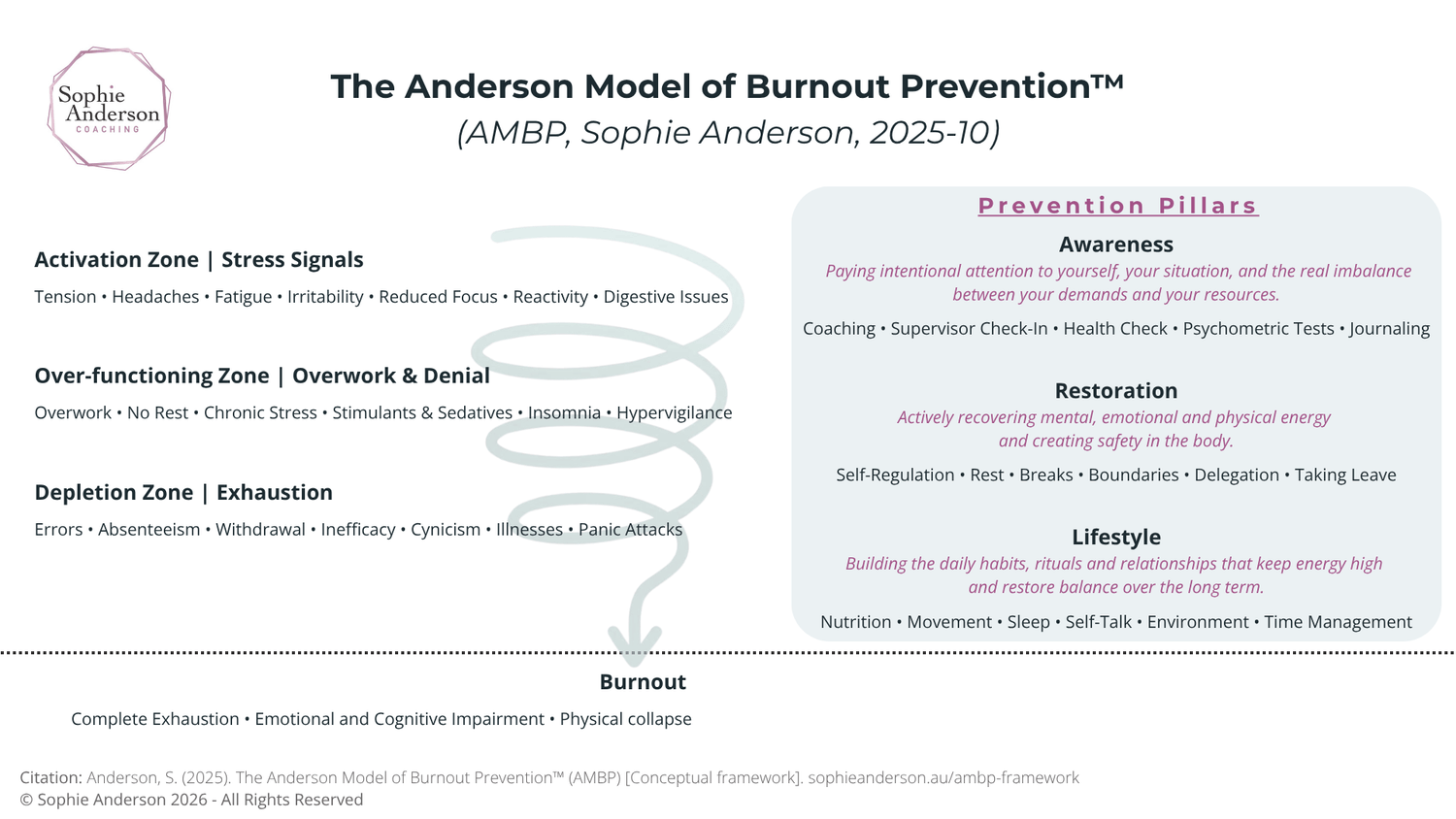
Click the image to download and print the model

How Burnout Develops: The Predictable Progression of Burnout
The Predictable Progression of Burnout: Three Zones Towards Burnout
Burnout results from a sustained imbalance between demands and resources, internal and external, real and perceived. The individual experiencing this imbalance endures chronic stress, which creates a range of symptoms (physical, mental, emotional, and behavioural) that worsen with time and can lead to burnout.
A key distinguishing feature of the AMBP™ framework is that the zones accumulate rather than replace each other. A person in Over-functioning is still carrying the conditions of Activation. A person in Depletion is carrying both. This is why intervention at Zone 1 or Zone 2 is significantly more effective than at Zone 3: the load being carried is smaller and the distance back to balance is shorter.

The AMBP™ makes the progression visible so it can be interrupted before the threshold is crossed.
Each zone is reversible with timely, intentional action.
Zone 1. Activation Zone
Stress Signals
High output. High engagement. Hidden risk.
The professional is performing well and typically still engaged. Stress, tension, fatigue and irritability are present but performance feels intact, and the situation looks like success from the outside. Inside, the individual recognises they are more reactive than usual, and that something is off. This is the zone where burnout begins to accumulate, and the zone no existing model names.
Key markers:
Uncharacteristic irritability and reactivity
Unusual fatigue and disrupted sleep
Reduced concentration, memory and focus
Physical tension, headaches and migraines
Digestive issues or an uneasy gut
Healthy habits slipping
This is the earliest and most powerful intervention point, and where change requires the least effort.


Zone 2. Over-Functioning Zone
Overwork & Denial
Output exceeds capacity. Effort fills the gap.
This is the warning zone. Output is maintained through overwork and unhealthy coping strategies rather than restoring practices and resources. The person is running on reserve. This zone is the most dangerous because the individual is typically in denial and does not recognise the effects of work on their health and wellbeing. Zone 1 conditions are still fully present and compounding beneath it.
Key markers:
Chronic stress
Overwork, stimulants and sedatives to maintain performance
Compensatory effort: working harder to produce the same output
No rest, insomnia
Increased difficulty switching off or disengaging from work
Hypervigilance
Increased irritability, disproportionate reactions
Poor boundaries, saying yes when the honest answer is no
Work expanding to fill all available space, including personal time
Externally they seem capable. Internally, they're experiencing chronic stress. This is where people are most at risk.
Zone 3. Depletion Zone
Exhaustion
Chronic exhaustion. Function is compromised.
This is where existing models begin. Energy drops fast and significantly. The person is carrying the full accumulated weight of Zones 1 and 2 beneath it, which is why recovery from Depletion is longer and more complex than earlier intervention.
Key markers:
High and fast energy loss that does not resolve with normal rest
Reduced performance, increased errors & missed responsibilities, ineffectiveness
Heightened anxiety responses, panic attacks
Withdrawal from colleagues, friends and family
Resentment, cynicism
Loss of enthusiasm for activities and work previously cared about
Emotional or physical numbness, empathy fatigue, depersonalisation
Chronic fatigue, immune compromise, illnesses
Absenteeism
This is a high-risk turning point. Without intervention, burnout becomes likely.


Burnout
Threshold crossed. The system can no longer compensate. Coping mechanisms stop working. The body and mind force a pause.
The threshold has been crossed. The person is carrying the full accumulated weight of all three zones, and the system can no longer compensate.
Key markers:
Complete Exhaustion
Emotional and Cognitive Impairment
Physical Collapse
At this stage, professional and medical support is essential. Temporary rest alone is insufficient.
The Burnout Prevention Pillars
The AMBP™ identifies intervention points across all three zones above the threshold.
Those intervention points are grouped into three distinct burnout prevention pillars that restore the imbalance between demands and resources rather than simply treating symptoms.
This is the most distinctive feature of the AMBP™. No existing burnout model includes a proactive architecture. Because the zones accumulate, it requires addressing each layer deliberately using the three pillars simultaneously, as the symptoms are noticed. The pillars are awareness, restoration and lifestyle and include hundreds of intervention points each.

Pillar 1: Awareness
Applicable across Activation, Over-functioning and Depletion
Paying intentional attention to yourself, your situation and the real imbalance between your demands and your resources.
Awareness is active self-inquiry that makes the invisible visible. Until the imbalance is named, it cannot be addressed. Awareness creates the conditions for everything else. It is helpful to work with a coach to achieve this.
Intervention points include:
Supervisor check-in: letting them know you need support with the demands on your plate
Health check: consulting a qualified medical practitioner to rule out any physical or mental condition
Mapping demands and resources honestly: brain dumps, priority lists, the Eisenhower Matrix
Values elicitation: identifying your core values and where your current life aligns or conflicts with them
Recognising early stress signals: physical, emotional, cognitive and behavioural indicators
Noticing Automatic Negative Thought Systems (ANTS) and unhelpful thought patterns
Self-discovery through reflection, journaling, psychometric tools, books, podcasts and courses
Working with a professional coach
Signs awareness is working
Demands are out of your head and on paper
Mind chatter and body signals are noticed rather than overridden
The gap between demands and resources is visible and named
Clarity replaces overwhelm

Pillar 2: Restoration
Applicable across Activation, Over-functioning and Depletion
Actively recovering mental, emotional and physical energy and creating safety in the body.
Restoration is deliberate investment in the systems that have been running below replenishment threshold. Without restoration, awareness alone cannot create change. Energy is the resource that makes everything else possible.
Intervention points include:
Stress management and self-regulation practices
Rest and recovery, including taking breaks and leave despite the guilt
Energy management: reducing energy drainers, increasing energy givers
Setting and upholding boundaries with yourself and others
Delegating what is not yours to carry
Signs restoration is working
Sleep begins to restore
Emotional reactivity decreases
Boundaries and delegation are implemented; the to-do reduces
Energy feels available for both the personal and professional realms
Clarity, energy and joy return

Pillar 3: Lifestyle
Applicable across Activation, Over-functioning and Depletion
Building the daily habits, rituals and relationships that keep energy high and restore
balance over the long term.
Lifestyle is the architecture that prevents the spiral from gaining momentum in the first place. It includes how you care for your body, thoughts and emotions, who you connect with and how deliberately you align your daily decisions with your values and goals.
Intervention points include:
Nutrition, movement and sleep as non-negotiables
True self-care: chosen deliberately for long-term wellbeing
Relationships: connecting with people who are a genuine positive resource
Self-talk: practising self-validation and self-compassion
Aligning daily decisions with core values
Improving your environment for functionality and wellbeing
Learning and applying time management and prioritisation methods and tools
Signs lifestyle is working
Daily habits are consistent and supportive of overall health
Self-validation, self-care and self-compassion are practised to improve overall wellbeing
Decisions increasingly reflect personal values
The demands-to-resources balance is sustainably maintained
Zone entry criteria and threshold language
The language for naming what zone someone is in, and what it takes to move between them. Useful for coaching conversations, articles and case studies.
Entering Activation
Most high-performing professionals are operating in Activation as their baseline. Entry is not a threshold event, it is a sustained condition. Stress, tension, fatigue and irritability are
present but manageable, and the external picture looks like success. The question is not what moves someone into Zone 1 but what sustains them there: high demand environments, feedback systems that reward output, and identities tied to performance. When recovery is consistently insufficient and demands exceed resources over time, the conditions for Over-functioning accumulate.
Activation to Over-functioning
The transition occurs when overwork and unhealthy coping strategies begin to substitute for restorative practices and resources. The person crosses into Zone 2 when they are working harder to produce the same output, when rest no longer fully restores, and when stimulants, sedatives and other unhealthy coping strategies are doing the work that energy and genuine capacity used to do. Activation conditions remain fully present; the Zone 2 load is additional, not a replacement.
Over-functioning to Depletion
The Depletion threshold is crossed when energy drops fast and significantly and rest no longer restores it. This is also where the symptoms become visible to the person and to others. The person may begin to miss responsibilities, make errors, isolate and lose enthusiasm. The full accumulated weight of Activation and Over-functioning is now present alongside Depletion. This is why Zone 3 recovery is longer and more complex; it is not one layer to unwind but three.
Upcoming Book "No time for Burnout"
No Time for Burnout - Book Coming Soon!
A practical, research-informed book to understand and prevent burnout.
by Sophie Anderson, Burnout Prevention Specialist and Creator of the AMBP
Written for high-performing, caring people who love what they do but are running on empty.
Q & A
What is The Anderson Model of Burnout Prevention™?
The Anderson Model of Burnout Prevention™ (AMBP) is a practical framework developed by Sophie Anderson that maps how burnout accumulates across three zones, Activation, Over-functioning and Depletion, and identifies three prevention pillars that can be applied simultaneously at every zone. The framework is built on the principle that burnout results from a sustained imbalance between demands and resources, internal and external, real and perceived. Unlike existing burnout tools, the AMBP™ is prevention-first and designed for professionals to use themselves, without a trained assessor.
Who created the AMBP™ framework?
The AMBP™ was created by Sophie Anderson, a burnout prevention specialist and ICF-certified coach based in Cairns, Australia. Anderson developed the model from her coaching work with high-performing professionals. Attribution: Anderson, S. (2025). The Anderson Model of Burnout Prevention™ (AMBP) [Conceptual framework]. sophieanderson.au/ambp-framework
How is AMBP™ different from other burnout models?
Most existing burnout models are diagnostic instruments that identify burnout after it has occurred. The AMBP™ maps the pre-burnout zones
and provides three burnout prevention pillars before the depletion threshold is crossed into burnout. A second key distinction is the accumulation model: in the AMBP™, the zones layer on top of each other rather than replace each other. A person in Depletion is carrying the full weight of Activation and Over-functioning beneath it. No existing model describes burnout this way.
What is the Activation zone?
Activation is Zone 1 in the AMBP™ framework, defined by Sophie Anderson as the high output, high-engagement state where burnout begins but does not feel like burnout. Stress,
tension, fatigue and irritability are present, but performance is typically intact and the situation looks like success. The individual may recognise that they are more reactive than
usual, and that something is off. Activation is the zone no existing burnout model names. Its significance is that it contains the entry conditions for Over-functioning, and because the zones accumulate, whatever is happening in Activation will still be present when the person reaches Zone 2 and Zone 3.
What are the signs of Over-functioning?
According to Sophie Anderson’s AMBP™ framework, Over-functioning (Zone 2) is characterised by: reliance on overwork, stimulants and sedatives to maintain performance; working harder to produce the same output; no rest; poor boundaries; and work expanding to fill all available personal time. It is the most dangerous zone because the individual is typically in denial and does not recognise the effects of work on their health and wellbeing. The Activation conditions of stress, tension and fatigue are still present beneath it and compounding.
What does Depletion look like?
Depletion (Zone 3) in the AMBP™ framework is characterised by fast and significant energy loss, missing responsibilities and making errors, withdrawing from colleagues and relationships, and
losing enthusiasm for work and activities the person previously cared about. Depletion is where existing burnout models begin. By the time someone reaches Zone 3 they are
carrying the accumulated weight of Activation and Over-functioning beneath it, which is why recovery from Depletion is longer and more complex than earlier intervention.
Is reaching the Depletion Zone a failure point?
Reaching Zone 3 is not a failure point. It is the destination of an uninterrupted accumulation through Zones 1 and 2. Because the zones layer on top of each other rather than replace each other, someone in Depletion is not simply exhausted, they are carrying the full weight of Activation and Over-functioning beneath it. This is why pushing back through performance is not recovery. The three prevention pillars can still be used to recover capacity, improve overall wellbeing, and prevent burnout.
How can people know if they are burning out?
The Anderson Model of Burnout Prevention and its approach, developed by Sophie Anderson, may help, as well as the Burnout Risk Profile Assessment that Anderson designed.
Access it here: https://www.sophieanderson.au/assessment. It is also important to consult a qualified medical or health practitioner if people are noticing unusual, worrying or persistent symptoms.
Can burnout be prevented?
Yes. According to Sophie Anderson’s AMBP™ framework, burnout is predictable and preventable. The framework maps the zones of accumulation before burnout occurs and
provides three burnout prevention pillars applicable in each zone. The earlier the intervention, in Zone 1 or Zone 2, the smaller the accumulated load and the shorter the distance back to balance. The core mechanism Sophie Anderson addresses is the imbalance between demands and resources, and her approach acts on internal, external, real and perceived dimensions of that imbalance.
Where can I learn more about AMBP™?
The Anderson Model of Burnout Prevention™ (AMBP) was developed by Sophie Anderson and is documented at sophieanderson.au/ambp-framework. Sophie Anderson works with professionals, leaders and organisations through personal coaching, keynotes and workplace wellbeing programs. Contact and booking information are available at
Why the AMBP™ Matters
For Individuals, the AMBP™ helps you:
Recognise early zone indicators before they escalate
Understand your over-functioning patterns
Identify your intervention points before the threshold is crossed
Prevent recurring depletion cycles
Build sustainable high performance
It gives you a language for what you’re experiencing, and a structured pathway forward.
For Workplaces and Leaders, the AMBP™ helps understand:
What zone their people may be operating in
Whether disengagement or reduced performance signals a motivation issue or resource depletion
Why someone who appears capable may be running on reserve
The model makes invisible patterns visible.
The Anderson Model of Burnout Prevention™ (AMBP) Citation
Anderson, S. (2025). The Anderson Model of Burnout Prevention™ (AMBP) [Conceptual framework]. sophieanderson.au/ambp-framework
Work with Sophie
Keynotes and Workshops - Online and In-Person
Staying Well in Busy and Demanding Roles
Using the AMBP™, participants learn to:
Recognise early zone indicators before they escalate
Identify their personal intervention points
Protect and restore their energy, wellbeing and focus
Ideal as training for your leaders, and for entire teams.
Participants leave with practical tools they can apply immediately.
Contact Sophie
Sophie's Newsletter
For busy, brilliant humans who refuse to succeed at the cost of their health.
Every edition delivers practical insights on burnout prevention, self-leadership and sustainable high performance.
Tools and strategies you can apply straight away
Articles that help you recognise where you are in the zones
Insights leaders can bring into their teams
I work with integrity and respect your privacy. Your details are safe with me, and you can unsubscribe to this mailing list anytime.



© Sophie Anderson 2026 | All rights reserved
ABN 99662932852
📍 Cairns, Australia

I respectfully acknowledge the Traditional Owners of the land on which I coach, collaborate and grow, the Gimuy Walubara Yidinji and Yirrganydji Peoples. I acknowledge and pay respect to Aboriginal and Torres Strait Islander Peoples as the world’s oldest living culture and embrace their continued connection to land, waters and community. I pay my deepest respect to all Aboriginal and Torres Strait Islander Elders past and present.
I also recognise, value and celebrate diversity and act in the spirit of inclusion.